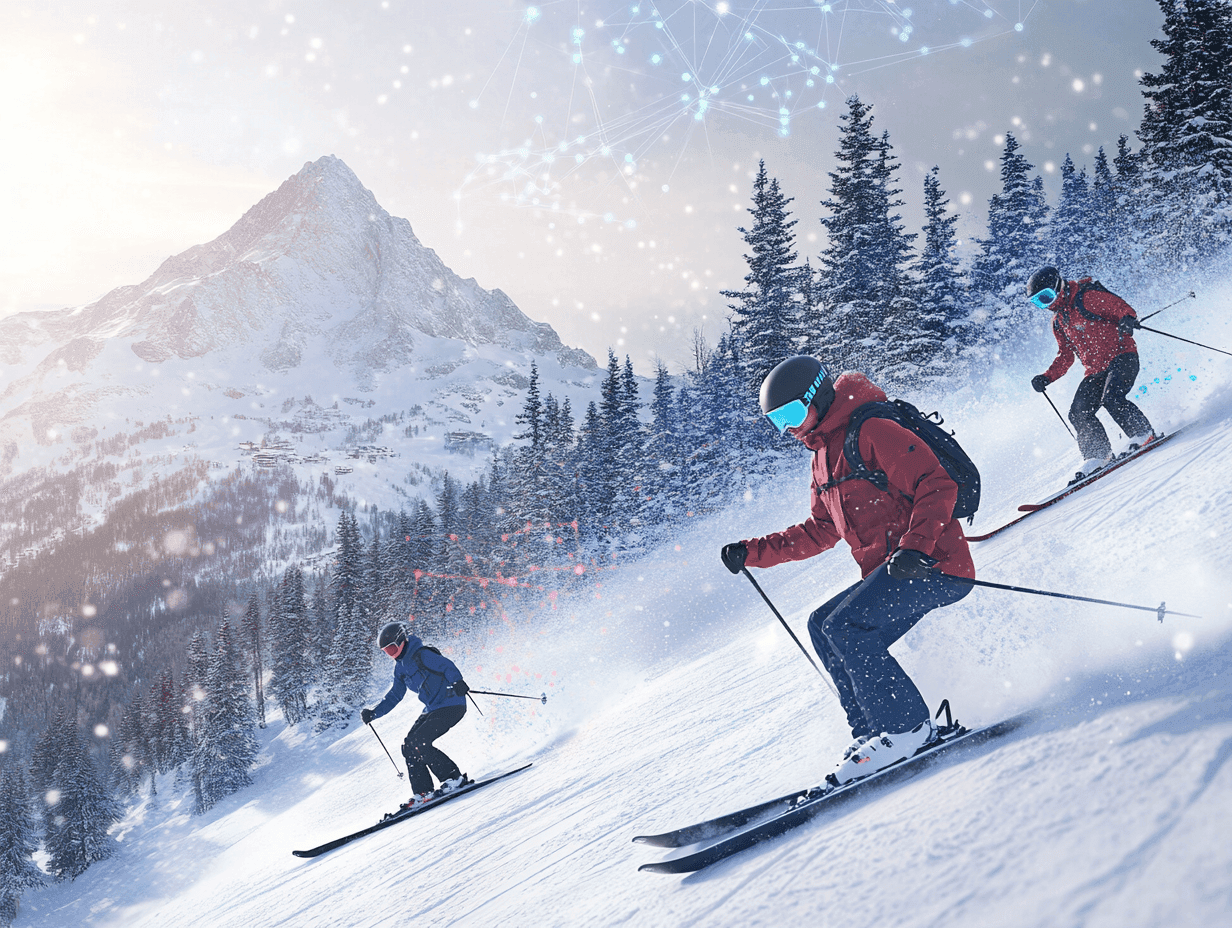
Every skier moves differently. Some carve crisp lines, others smear and float, and many blend multiple techniques into a style that's uniquely their own. For decades, ski instruction wrestled with how to support this individuality while still building strong fundamentals. The solution? The Skills Concept — a foundational teaching approach that not only changed how skiing was taught but empowered skiers to improve without sacrificing their personal style.
A Shift from Rigid Progressions to Skill-Focused Teaching
In the mid-1970s, the Professional Ski Instructors of America (PSIA) recognized a growing gap. The sport had evolved — ski styles diversified, and equipment improved — yet instruction remained overly rigid. The launch of the American Teaching Method™, which later became the American Teaching System™, introduced a groundbreaking idea: instead of teaching one “correct” way to ski, focus on the building blocks of movement.
By emphasizing motor skills as the basis for learning, PSIA helped instructors tailor lessons to match what students actually wanted: not just competency, but self-expression on snow. This shift was officially introduced at the 1975 Interski Congress in Czechoslovakia, where the Skills Concept made its international debut.
The Three Core Skills
PSIA’s 1977 manual formalized ski mechanics into three basic skills:
Edging
Turning (or Rotary Movement)
Pressure Control
Though balance was considered an ability rather than a skill, it remained a prerequisite for all skiing actions. The revolutionary aspect was how these skills could be blended in different intensities to match different skiing styles and goals — a concept known as skill blending.
This opened the door to student-centered teaching: instead of forcing skiers into identical forms, instructors could observe their students’ goals and tailor instruction using a precise mix of skill development.
Evolving Terms, Same Core Principle
As skiing progressed through the 1980s and 1990s, so did terminology. Some instructors preferred terms like “rotary” over “turning,” and began viewing balance as a skill itself. This led to two complementary ways of describing the Skills Concept:
View A:
Controlling pressure
Controlling edging
Controlling turning
Balancing while in motion
View B:
Pressure control movements
Edging movements
Rotary movements
Balancing movements
Both frameworks emphasized the complexity and nuance of skiing. Whether you focused on “control” or “movement,” the key was the same: understand what the skis are doing, and identify the specific body movements that cause those results.
As Rob Sogard, PSIA Alpine Team Coach, puts it:
“PSIA continues to support the opinion that specific and definable movements are used to effectively produce the desired action of the skis on the snow.”
The Legacy and Modern Relevance of the Skills Concept
Fast forward to today, and skiing has exploded in style and diversity. Skiers are now carving groomers, skiing switch, airing into halfpipes, and floating through backcountry powder. Equipment has followed suit, with designs built for previously unimaginable terrain.
Yet the Skills Concept remains relevant. Whether you're a coach guiding a racer, a freestyle athlete inventing new tricks, or a weekend skier working on control, the blend of pressure, edge, and rotary control remains the technical foundation.
Even in the AI era — with tools like Sprongo offering deep biomechanical analysis — understanding skiing through the Skills Concept helps make data meaningful. When we interpret AI feedback through this framework, we don’t just see numbers — we see how to adjust movement patterns, refine efficiency, and preserve personal style.
Final Thought: A Timeless Framework for Modern Innovation
The essence of skiing has always been a dance between structure and freedom. The Skills Concept made it possible for instruction to evolve from rigid systems to flexible, student-centered guidance. And it still matters today — especially as we blend traditional fundamentals with modern tools like AI-powered video analysis.
If you want to teach or learn skiing in a way that’s technically sound and uniquely your own, the Skills Concept remains your strongest foundation.