Why video matters so much in college ski racing
College ski racing is a team sport scored one racer at a time. Under the current NCAA format, alpine and Nordic results add up to one team score, with slalom and giant slalom each raced over two runs on a reset course. Every hundredth a racer finds adds points for the team.
Training time on snow is limited, and courses, conditions and light change constantly. Video is how coaches turn a few training runs into clear feedback, and how racers keep learning on the chairlift and in the lodge.
Filming slalom and GS training
- Stand on the side of the course where you can see the racer through several gates in a row. Above the gate you care about, looking across and slightly down, often shows the line and body position best.
- Keep the phone steady and pan smoothly. A pole or monopod helps.
- Film the same section for every racer, from the same spot, so runs compare fairly.
- Keep the sun behind or beside you; bright snow behind the racer turns them into a silhouette.
- Say the racer's name at the start of each clip. In Sprongo, a name spoken in the first 5 seconds is tagged automatically, which saves a lot of sorting after a session with a full team.
For slalom, the rhythm is quick, so frame a rhythm section of several gates. For GS, step back further to hold full turns between gates.
What to look for in a race turn
Pick the same moments in each turn and look at them every run:
- Line: where the turn starts relative to the gate, and whether the racer is early and round or late and straight.
- Transition: how the racer moves from the old turn to the new one, and when the new edges engage.
- Top of the turn: building pressure early, rather than waiting and forcing it at the gate.
- Body position: balance over the skis, a stable upper body and active hands.
- Exit: balanced and ready for the next gate, or recovering.
Slalom also adds gate clearing, and GS rewards a clean, carved arc at higher speed.
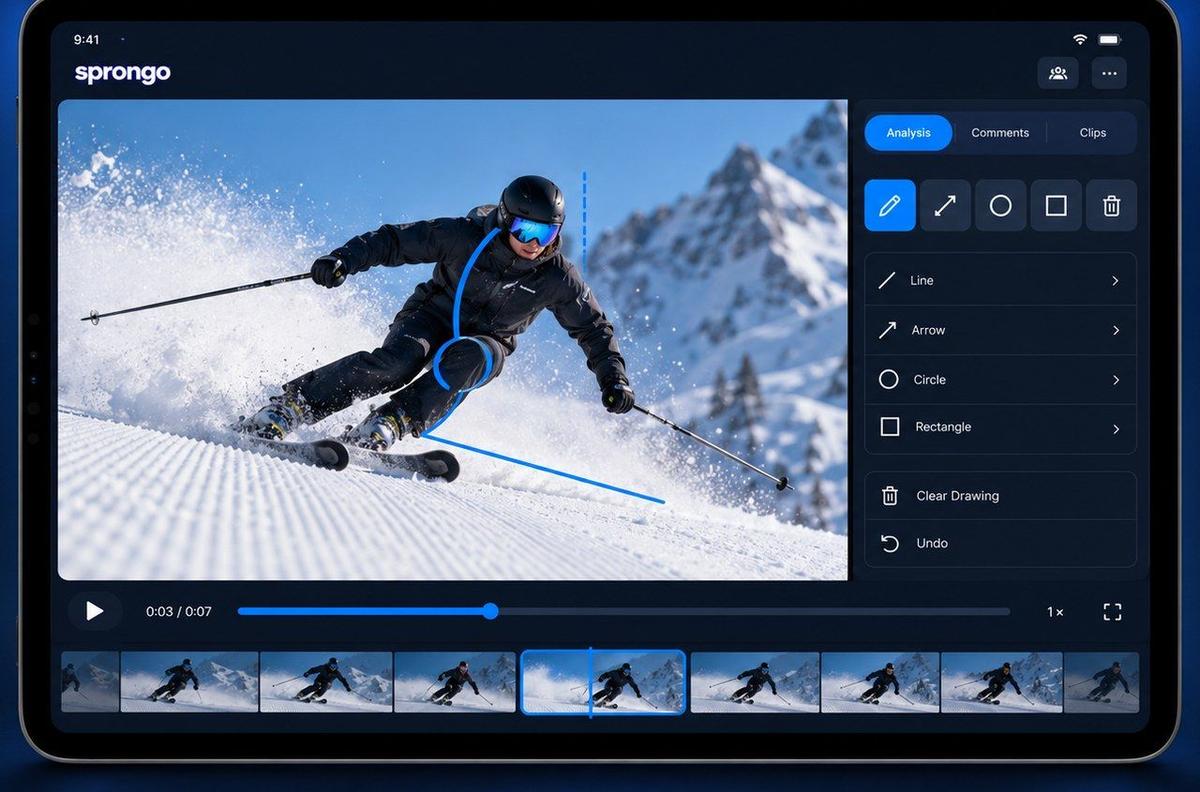
Follow one body part at a time. The knee is a great place to start: it shows a lot about stance and flexion through the turn. That's exactly what our launch film shows: one GS turn, with the knee tracked through it.
Track the turn with Path Track
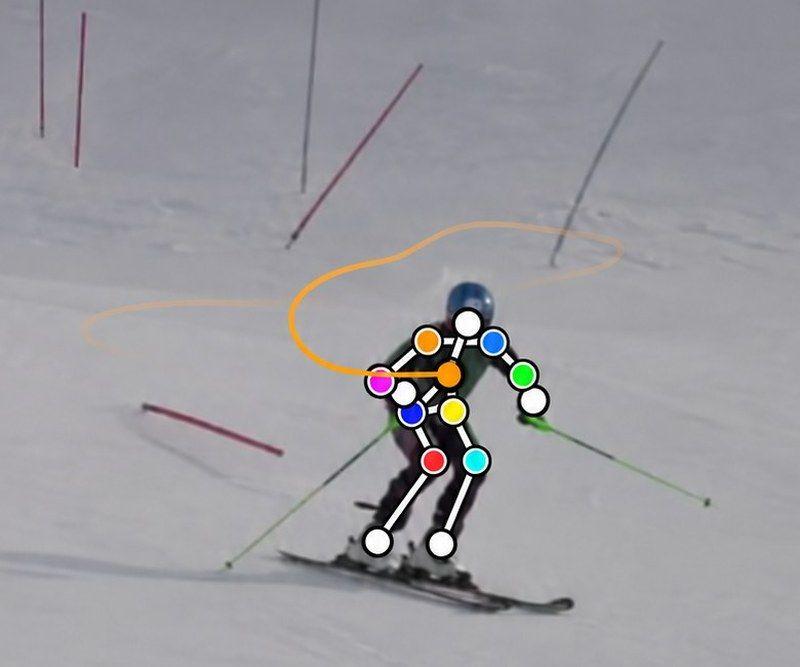
In Sprongo, Path Track traces the center of mass or any joint through the movement, in the color you choose, with joint angles shown on the athlete.
- Trace the center of mass to see the racer's line and how it moves across the skis through transition.
- Trace the knee to see how the angle changes from the top of the turn to the exit.
- Compare left and right turns. Many racers have a stronger side.
Ask SIVA about one turn
SIVA, Sprongo's AI video assistant, answers a focused question about a clip using the movement data in it. Select a joint, choose the moment and ask, for example:
- "How does my knee move through this GS turn?"
- "Am I balanced at the exit of this turn?"
- "Is my upper body quieter on my left turns or my right turns?"
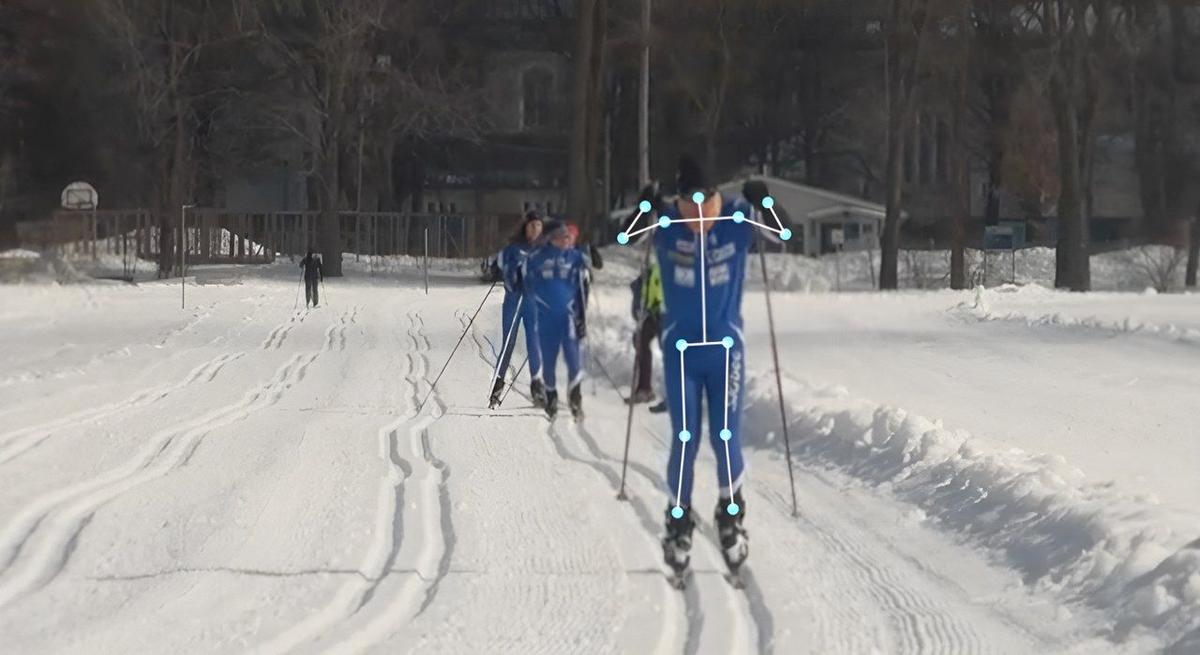
SIVA tells you what it noticed and suggests a next focus. It reads 2D video, so a racer coming straight at the camera hides a lot; a view across the hill works best. It supports your coaches; it doesn't replace them.
Compare runs, not memories
The biggest gains come from comparing runs. In Sprongo, pick Compare from any clip, sync two runs and slow them down to see exactly where they split, side by side or overlaid.
- Two racers on the same section, to show a line choice.
- The same racer before and after a drill.
- The fastest training run against a slower one.
Line both clips up on the same gate. The first place the runs look different usually matters more than anything after it.
Feedback that reaches racers between runs
Draw on the frame, leave a voice note, and share the exact moment, so racers can watch their feedback on the chairlift before the next run. Mark key frames with a Moment and add them to the racer's playlist for the video meeting that evening.
Sprongo works the same on iPhone, Android, tablet and the web: film on the hill, then review the same clip on a laptop in the lodge.
Running video for a whole team
College ski teams have men's and women's alpine and Nordic squads, several coaches and a lot of travel. A shared library keeps everyone aligned:
- One team workspace with shared libraries and team playlists, member management and coaching annotations.
- Playlists per racer and per training camp, and tags for discipline (SL, GS), session and conditions.
- Stars for the best runs, ready for video meetings and season reviews.
Team plans are purchased on the web: Small Team $49 a month for up to 20 members, Large Team $99 for up to 100, and Extra Large $159 for up to 300. Who can join and see what depends on the team's privacy settings.
Common mistakes
- Filming from the bottom of the course, where depth is hidden.
- Different filming spots for different racers.
- Judging technique on a run where the racer was recovering from a mistake.
- Too many corrections at once.
- Watching only in slow motion. Watch at full speed first for rhythm.
Get your team on one video library
Film on the hill, review in the lodge, and keep every racer's feedback in one place.
Talk to us about a team plan · Get PRO, $10/month · App Store · Google Play