A ski turn does not happen because the skier wants to turn.
It happens because forces change.
What we often describe as balance, edge control, or carving skill is, at its core, the ability to manage how the snow pushes back against the skis. The skier’s body reacts to this interaction—it does not command it.
Understanding this distinction changes how we coach, how we move, and how we progress.
Direction Change Is Acceleration
In skiing, acceleration is rarely about speed.
Most of the time, it is about direction.
When a skier enters a turn, their velocity vector changes continuously. Even if speed remains constant, this directional change requires acceleration. Physics defines this as centripetal acceleration, and it must be caused by a real force.
That force does not come from the skier’s muscles.
It comes from the snow.
Centripetal Force Is Created at the Ski–Snow Interface
Centripetal force is the lateral force exerted by the snow on the skis, directed toward the center of the turn.
It exists only if:
The skis are edged into the snow
The skis bend into an arc
The snow is capable of providing resistance
No edge, no force.
No force, no turn.
This is why turning cannot be achieved by rotating the upper body or “forcing” the skis across the fall line. The turn is a result, not an instruction.
Why the Body Feels Pulled Outward
Many skiers report a strong sensation of being pulled outward during a turn. This sensation is real—but the force is not.
There is no outward force acting on the skier. What is felt is inertia: the body’s resistance to changing direction while the skis are being redirected inward by the snow.
This distinction matters.
When skiers try to “fight” this sensation, they often disrupt balance instead of improving it.
Balance Is Alignment with Force, Not Stillness
In a turn, multiple forces act simultaneously:
Gravity acting downward
Snow reaction force acting through the skis
A lateral component providing centripetal force
The skier’s body must align with the resultant of these forces.
Leaning into a turn is not a stylistic preference or a sign of aggression.
It is a necessary geometric response to force balance.
As speed increases or turn radius decreases, the required alignment becomes more precise—not more aggressive.
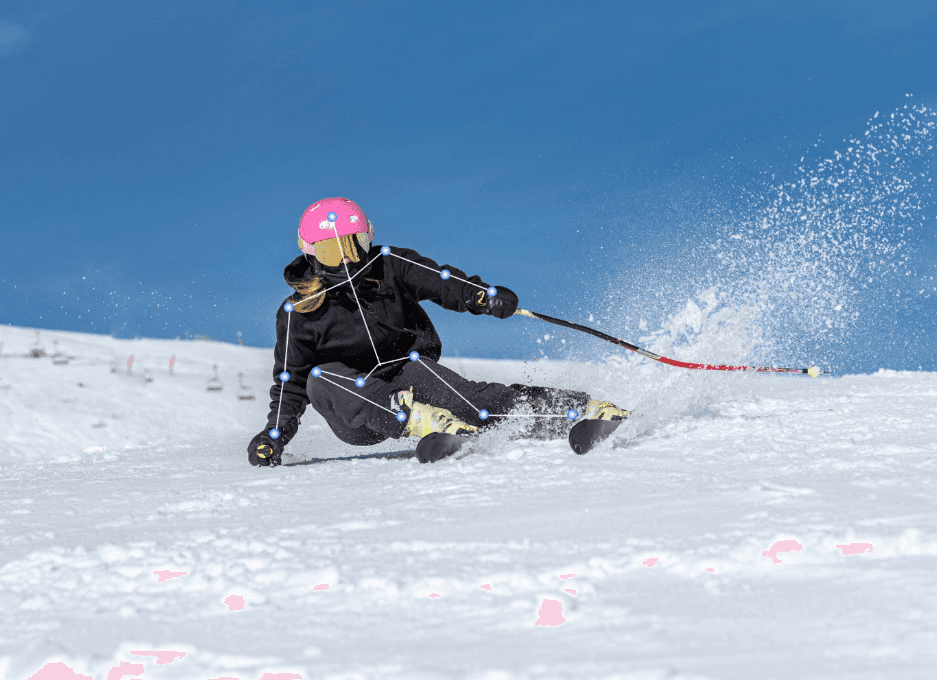
What the Images Really Show
In the visuals above, the skier is not “holding” the turn with strength.
They are positioned so that:
The skis can bend
The snow can push back
Forces can resolve through the body without interruption
The still image captures a dynamic equilibrium: constant motion, constantly balanced.
Coaching Implication
Effective coaching does not start with body parts.
It starts with cause and effect.
When skiers understand that:
Turns are created by forces
Forces are created by interaction
Movement is a response, not a command
Technique becomes simpler, not more complex.