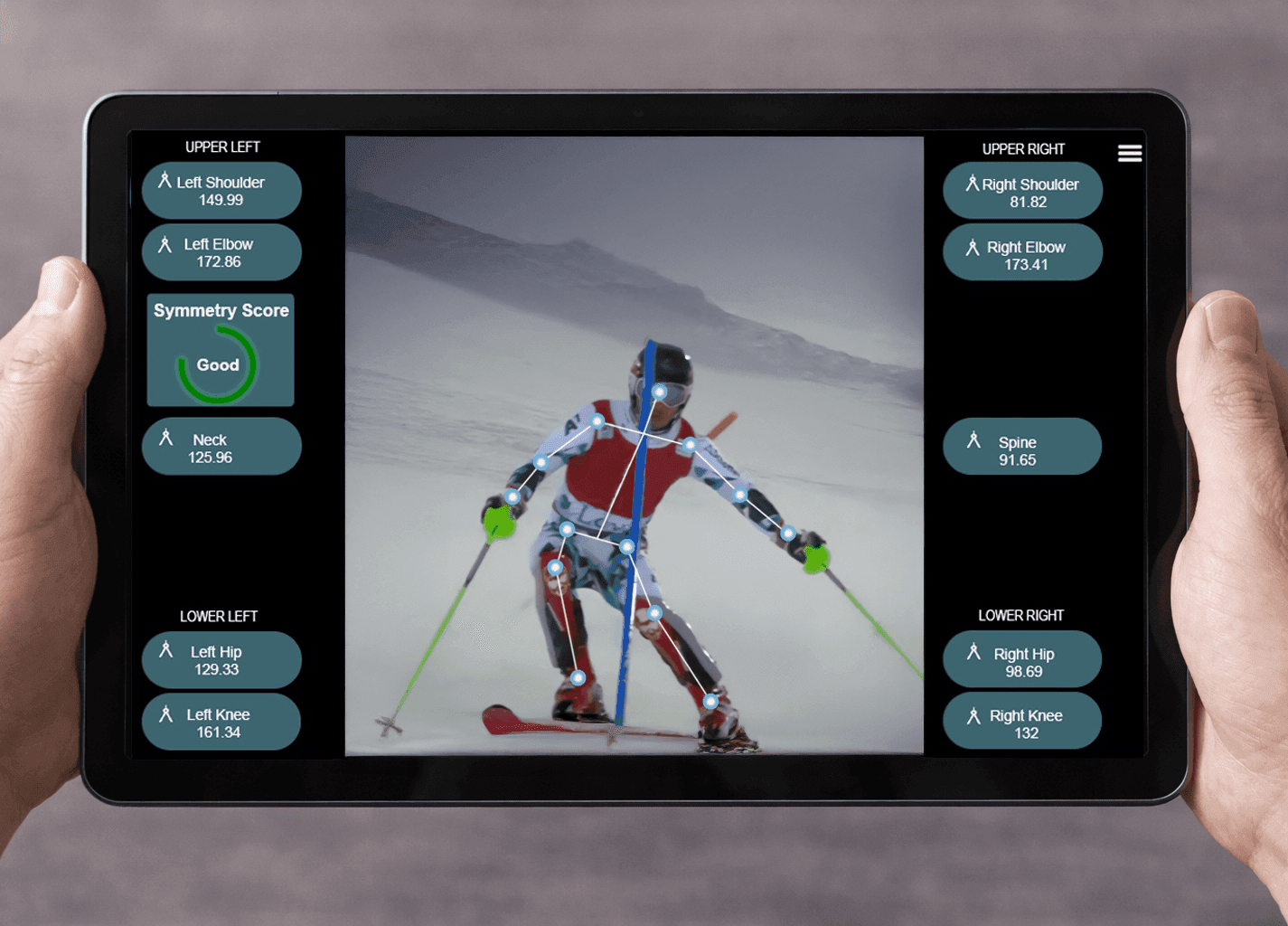
For years, biomechanical analysis required controlled environments. Motion capture labs, reflective markers, specialized suits, and calibrated camera systems were considered the standard for accurate measurement. While highly precise, these systems were expensive, complex, and limited to specific environments.
Markerless video analysis changes that model fundamentally. By using computer vision to detect and track anatomical landmarks directly from standard video, movement can be measured without physical markers or wearable hardware.
This shift does not simplify biomechanics. It makes it accessible.
From Lab Dependency to Field Measurement
Traditional motion capture systems rely on markers attached to the athlete’s body. Cameras track these markers to reconstruct joint positions in three-dimensional space. Although effective, this process introduces preparation time, equipment dependency, and environmental constraints.
Markerless systems remove that dependency. Instead of tracking physical markers, computer vision models identify human landmarks directly from pixel data. Each frame is analyzed, and anatomical reference points are mapped digitally.
This enables movement analysis in real training environments—on the field, on the track, on the slope, or in the gym.
Consistency Without Interference
Physical markers can shift, detach, or interfere with natural movement. Wearable sensors may alter biomechanics subtly. Markerless analysis eliminates these variables.
Because athletes perform in their natural training state, the recorded data reflects authentic movement patterns. Measurement becomes less intrusive and more representative of real performance.
Scalability and Practicality
Marker-based labs are powerful but difficult to scale. They require infrastructure, calibration, and controlled conditions. Markerless video analysis scales differently. If video can be captured, movement can be measured.
This creates opportunities for longitudinal tracking outside laboratory settings. Teams, academies, and individual athletes can document technique over time without relocating to specialized facilities.
Precision Through Computer Vision
Markerless does not mean approximate. Advanced pose estimation models are trained on large datasets to detect human joint positions with high consistency. When combined with structured processing pipelines, these models generate repeatable biomechanical metrics.
The strength of markerless analysis lies in combining accessibility with structured data output.
A Structural Shift in Performance Analysis
Markerless AI video analysis does not replace high-end laboratory systems in every context. Instead, it expands where and how measurement can occur.
It transforms video from a passive recording tool into a scalable measurement infrastructure
The future of movement analysis is not limited to laboratories. Markerless video analysis enables objective measurement in real-world environments. By removing hardware constraints while maintaining structured data extraction, it opens a broader path toward scalable, consistent performance documentation.