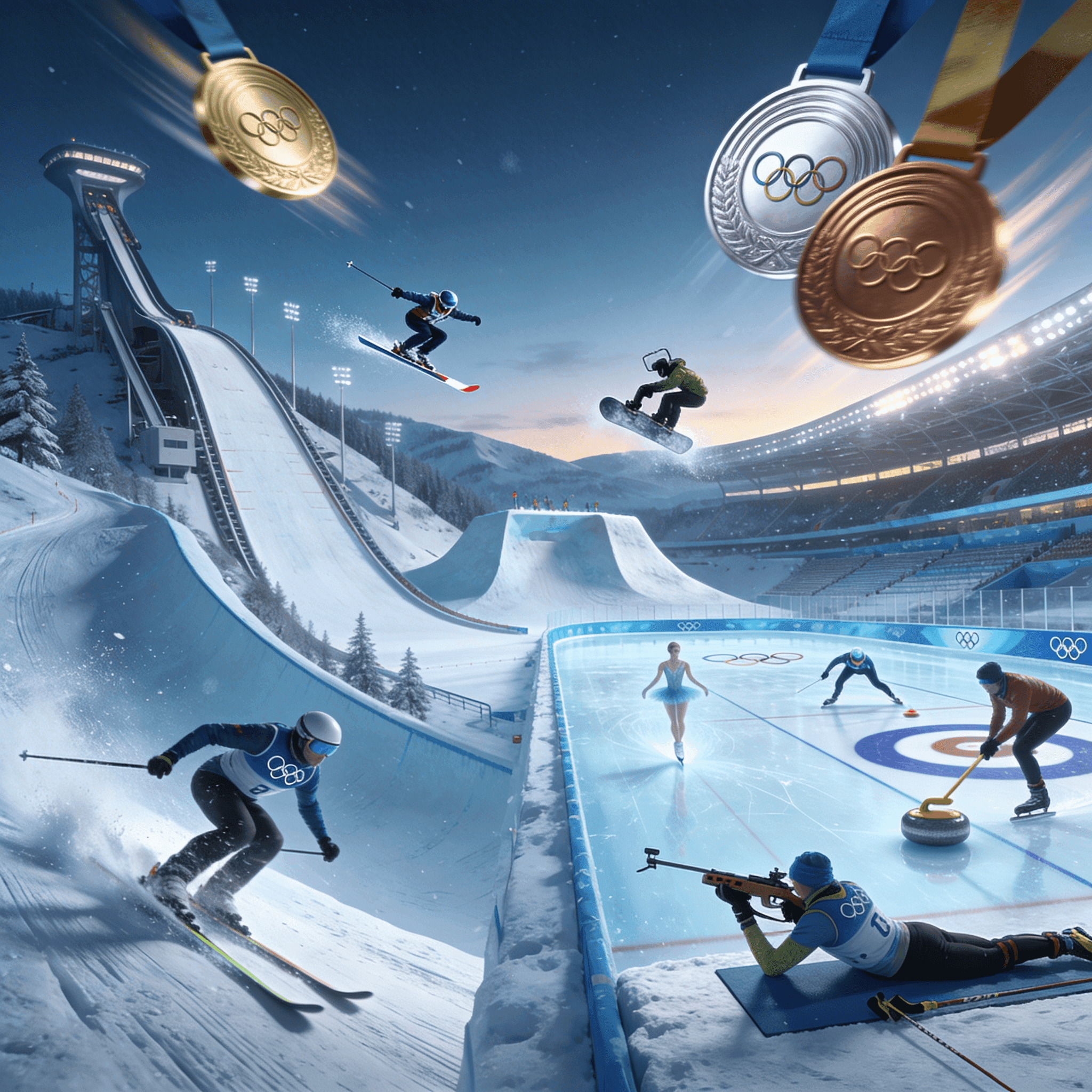
The 2026 Winter Olympics are underway and while the world focuses on podium ceremonies, the medal standings reveal something deeper.
Beyond celebration, the leaderboard reflects conversion.
Preparation into execution.
Speed into control.
Pressure into performance.
At Olympic level, outcomes are rarely separated by large margins. They are decided by timing, balance, sequencing, and the ability to maintain technical integrity under extreme conditions.
The medal table is not just a ranking system. It is a performance snapshot.
🥇 Current Top 10 Medal Standings – Winter Olympics 2026
Rank | Country | Gold | Silver | Bronze | Total |
1 | Norway | 15 | 8 | 9 | 32 |
2 | Italy | 9 | 4 | 12 | 25 |
3 | United States | 6 | 11 | 6 | 23 |
4 | Germany | 5 | 8 | 8 | 21 |
5 | Japan | 4 | 6 | 10 | 20 |
6 | Austria | 5 | 8 | 4 | 17 |
7 | France | 5 | 7 | 4 | 16 |
8 | Netherlands | 6 | 6 | 1 | 13 |
9 | Sweden | 6 | 5 | 2 | 13 |
10 | Canada | 3 | 4 | 5 | 12 |
Norway Sets the Standard for Repeatable Performance
With 32 total medals and 15 gold, Norway currently leads the standings.
This is not a result of isolated brilliance. It reflects structural consistency across disciplines such as cross-country skiing and biathlon, where pacing, energy transfer, and fatigue management directly impact podium conversion.
Sustained control under pressure produces volume.
And volume builds leadership.
Italy and the United States: Precision at the Margins
Italy’s 25 medals demonstrate competitive depth, particularly in alpine and sliding events. High-speed directional control and disciplined transitions are translating into consistent podium appearances.
The United States, with 11 silver medals, highlights how small the margins truly are. When outcomes are determined by tenths or even hundredths of a second, micro-adjustments in landing stability, edge pressure, and timing become decisive.
At this level, proximity to gold is measurable.
Germany and Japan: Stability as Strategy
Germany’s balanced medal distribution suggests repeatable execution across events.
Japan’s 10 bronze medals indicate frequent finals presence — a sign of performance systems that consistently produce contention opportunities.
In elite winter sport, being consistently competitive is not accidental. It reflects structured preparation and controlled execution.
The Competitive Cluster: Depth Across Disciplines
Austria, France, Netherlands, Sweden, and Canada remain tightly grouped in total medal count.
The Netherlands and Sweden, each securing 6 gold medals, show concentrated dominance in targeted disciplines.
Canada’s balanced medal spread reflects broader participation strength across events.
In this tier, marginal improvements in acceleration phases, rotational control, landing absorption, and transition timing often determine podium separation
What the Medal Standings Reveal
The Winter Olympics 2026 medal table highlights four critical performance insights:
Depth across events increases total podium volume.
Gold conversion depends on execution precision under pressure.
Stability under fatigue preserves competitive advantage.
Small technical refinements create measurable outcomes.
At Olympic level, talent alone is insufficient.
Execution consistency determines ranking position.
Final Perspective
The Winter Olympics are a global stage where competitive edge becomes visible.
Control at speed.
Balance under load.
Precision under pressure.
As the competition progresses, the standings will evolve but the pattern remains consistent.
Those who execute cleanly, repeatedly, and efficiently under constraint rise to the top.
And in elite sport, edge is never accidental.