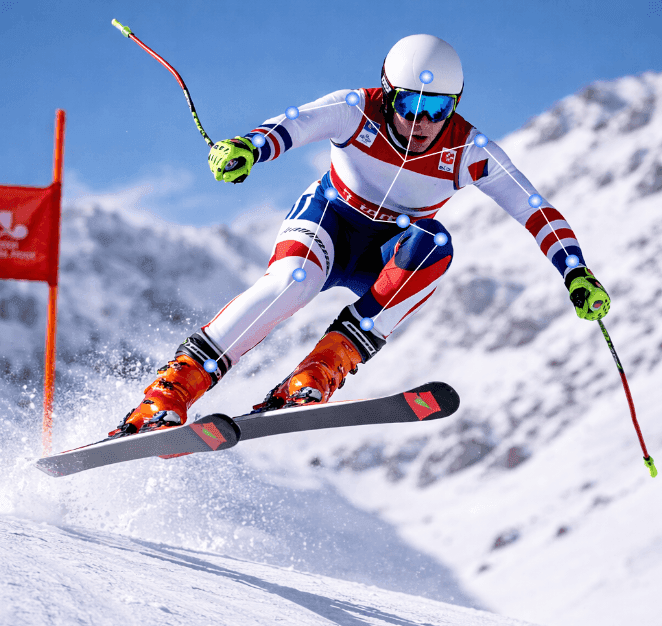
Alpine skiing begins where hesitation ends.
There is no neutral speed on a mountain. Every turn demands intent, every line asks for commitment before it offers any sense of control in return. Unlike many winter sports, alpine skiing doesn’t allow athletes to grow into the moment. The moment arrives fully formed, and the skier either meets it — or doesn’t.
What defines alpine skiing is not just velocity, but exposure. Snow conditions shift without warning. Visibility changes mid-run. Terrain offers no second chances. Control isn’t something recovered after a mistake; it’s something protected relentlessly from the first gate onward.
Each discipline reveals a different relationship with risk. Downhill rewards trust — in equipment, preparation, and instinct — at speeds that leave no margin for correction. Slalom compresses decision-making into fractions of a second, where rhythm matters more than raw power. Giant slalom lives between those extremes, asking athletes to balance aggression with restraint over sustained runs.
Alpine skiing also strips performance down to its essentials. There is no opponent to react to in real time. No adjustment once the run begins. The only variable is execution — and the mountain’s response to it.
That’s why the best alpine skiers don’t look frantic. Their strongest runs feel quiet. Not because they lack intensity, but because nothing interrupts the line. The body moves, the terrain responds, and the clock remains irrelevant until the finish.
The Athletes Who Set the Standard
Modern alpine skiing is shaped by athletes who have redefined what consistency at the edge looks like.
Mikaela Shiffrin has transformed the idea of reliability at speed, proving that precision can hold across seasons, disciplines, and conditions. Her success isn’t built on risk-taking alone, but on the ability to repeat excellence when the mountain refuses to stay predictable.
On the men’s side, Marco Odermatt continues to push boundaries through control rather than chaos, reading terrain with an intuition that makes difficult lines appear inevitable. Skiers like Aleksander Aamodt Kilde represent the raw force of downhill racing, while Petra Vlhová thrives where adaptability matters most.
These athletes don’t chase danger. They manage it — deliberately, relentlessly, and without hesitation.
Where Sprongo Fits
Alpine skiing rewards decisions made before the moment arrives. Preparation, pattern recognition, and understanding risk shape outcomes long before the first turn.
That same logic applies beyond the mountain.
Sprongo exists for environments where performance depends on reading complexity early — identifying signals, understanding behavior, and acting before uncertainty turns into consequence. Whether on snow or in systems built around human decisions, success belongs to those who commit with clarity.
Alpine skiing doesn’t wait for confidence.
Neither do high-stakes systems.