In high-performance environments, efficiency is often discussed but rarely defined. Coaches describe athletes as “more efficient,” “cleaner,” or “technically sound,” yet these evaluations are typically observational. Technique Efficiency™ introduces a structured way to define and measure what efficiency actually means.
Rather than treating efficiency as a subjective impression, Technique Efficiency™ frames it as a measurable construct derived from biomechanical data. It translates movement quality into structured metrics that can be analyzed, compared, and tracked over time.
From Observation to Construct
In speed skating, efficiency depends on how effectively lateral force is converted into forward glide. Small variations in hip alignment, knee flexion timing, torso angle, or stride symmetry can influence energy transfer. These differences are often subtle and difficult to quantify visually.
Technique Efficiency™ organizes these biomechanical variables into a structured measurement framework. Instead of asking whether a movement “looks smooth,” the system evaluates specific measurable components such as joint angles, segment alignment, symmetry balance, and temporal coordination.
Efficiency becomes definable rather than interpretive.
The Components of Technique Efficiency™
Technique Efficiency™ is not a single metric. It is a construct composed of multiple biomechanical indicators. These may include:
Joint angle consistency during propulsion
Symmetry between left and right phases
Stability of spinal alignment
Timing coordination between upper and lower body segments
Force direction relative to movement path
Each variable contributes to a structured representation of technical execution.
In speed skating, for example, excessive lateral deviation in hip position or asymmetrical knee extension can reduce glide efficiency. When these deviations are measured numerically, they can be tracked longitudinally.
Why a Construct Matters
A construct is more than raw data. It organizes multiple measurements into a coherent analytical model. Technique Efficiency™ does not replace expertise; it provides a framework within which expertise operates.
By structuring efficiency into measurable variables, performance evaluation becomes repeatable. Two sessions can be compared using the same analytical criteria. Improvements are documented numerically rather than inferred visually.
This reduces ambiguity in performance discussions.
Interface and Visualization
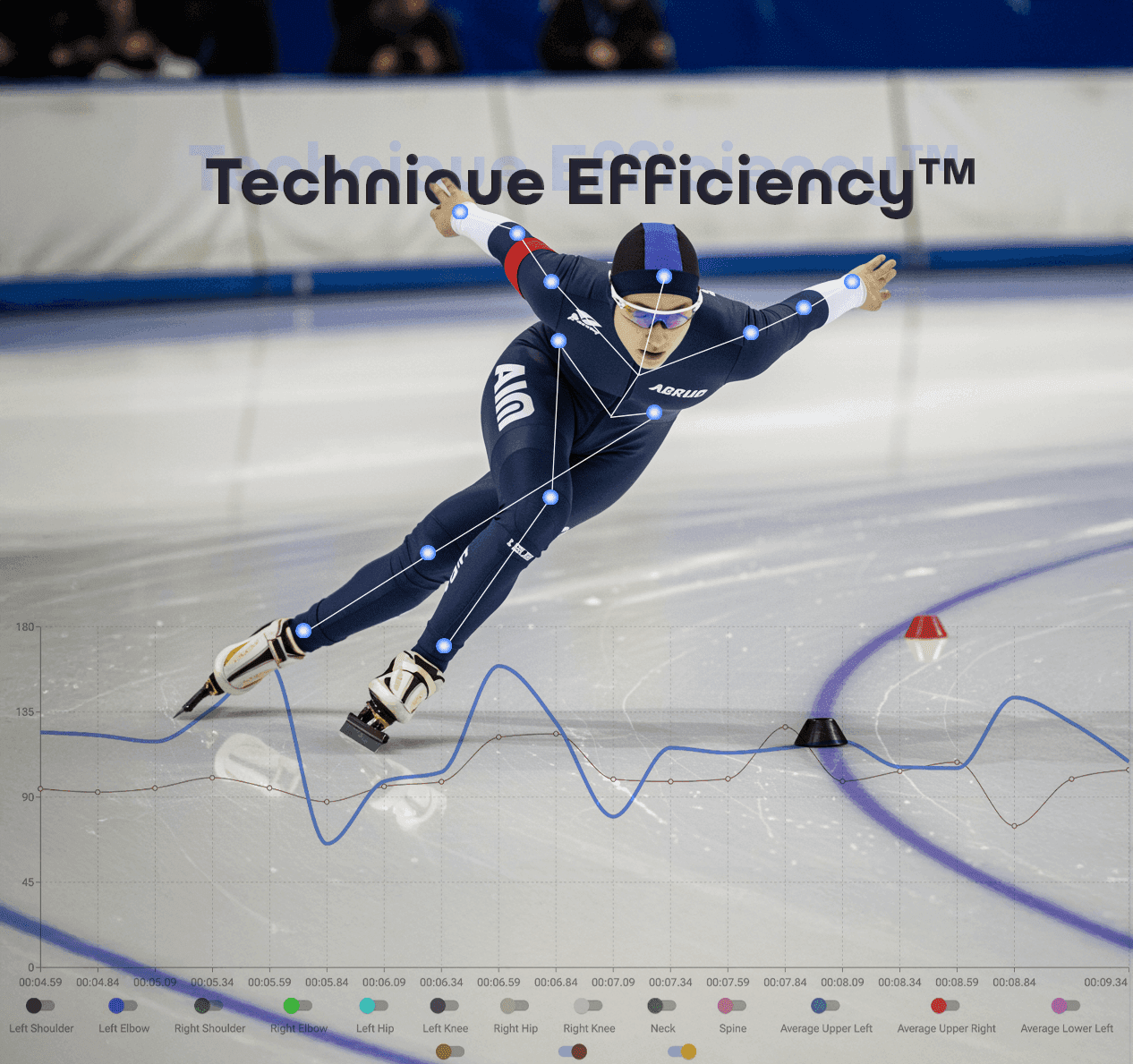
Within the AI Video Analysis® interface, Technique Efficiency™ metrics are presented alongside joint angle values and symmetry scores. Graphical trends illustrate how movement variables fluctuate over time.
The visualization does not judge performance. It reports structured measurements that describe how efficiently technique is executed.
Interpretation remains human. Measurement remains objective.
Longitudinal Application
Efficiency is rarely static. It evolves through training cycles, fatigue states, and technical refinement. Technique Efficiency™ allows athletes and coaches to observe these changes over time.
By documenting structured metrics across sessions, efficiency becomes trackable. Instead of relying on perception, professionals can analyze trends and identify measurable shifts in technique.
This transforms efficiency from a descriptive term into a documented performance variable.
Final Perspective
Technique Efficiency™ represents a shift from subjective evaluation to structured measurement. By organizing biomechanical variables into a coherent construct, it defines what efficiency means in measurable terms.
In sports like speed skating, where small technical deviations affect performance outcomes, this clarity matters. Efficiency is no longer an impression. It is a measurable dimension of movement.